

Mouse GEP Protein (GEP-MM101)
$243.00 – $810.00
KACTUS Biosystems Mouse GEP Protein (GEP-MM101) (catalog No. GEP-MM101) is expressed from HEK293 with His tag at the C-Terminus.It contains Thr18-Leu589.

- Details & Specifications
- References
| Catalog No. | GEP-MM101 |
|---|---|
| Product Name | Mouse GEP Protein (GEP-MM101) |
| Supplier Name | KACTUS Biosystems |
| Brand Name | KACTUS Biosystems |
| Synonyms | Progranulin; PGRN; Acrogranin; GP88; Glycoprotein 88; PCDGF; PEPI; CLN11; GEP; Granulin; GRN |
| Species | Mouse |
| Source | HEK293 |
| Accession | P28798 |
| Product Tag | C-His |
| Biotinylated | no |
| Exact Sequence | Thr18-Leu589 |
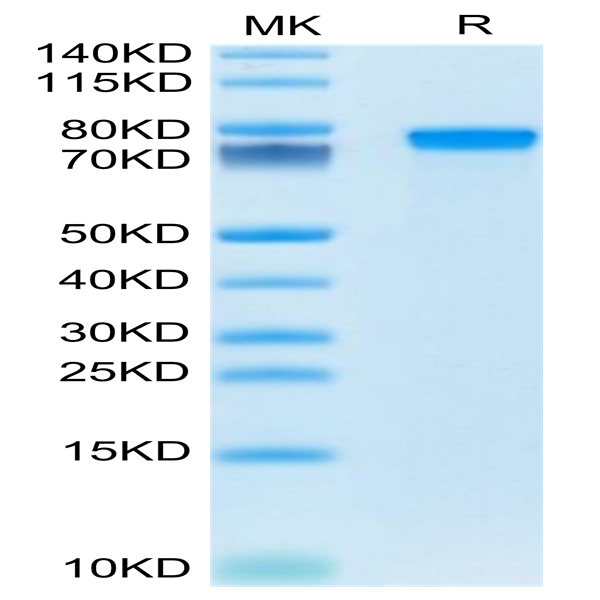
| Molecular Weight | The protein has a predicted MW of 62.7 kDa. Due to glycosylation, the protein migrates to 70-80 kDa based on Tris-Bis PAGE result. |
| Form | Lyophilized |
| Formulation | Lyophilized from 0.22μm filtered solution in PBS (pH 7.4). Normally 8% trehalose is added as protectant before lyophilization. |
| Reconstitution | Centrifuge the tube before opening. Reconstituting to a concentration more than 100 μg/ml is recommended. Dissolve the lyophilized protein in distilled water. |
| Purity | > 95% as determined by Tris-Bis PAGE;> 95% as determined by HPLC |
| Endotoxin | Less than 1EU per μg by the LAL method. |
| Shipping | Shipped at ambient temperature. |
| Stability & Storage | '-20 to -80°C for 12 months as supplied from date of receipt.;-20 to -80°C for 3-6 months in unopened state after reconstitution.;2-8°C for 2-7 days after reconstitution.;Recommend to aliquot the protein into smaller quantities for optimal storage. Please minimize freeze-thaw cycles. |
| Note | Products will be shipped from the warehouse in Massachusetts. Promotion is running from time to time. Welcome to send a request for quote to message@sydlabs.com. |
| Order Offline | Syd Labs, Inc. 4 Avenue E, Hopkinton, MA 01748 USA. Phone: 1-617-401-8149 Fax: 1-617-606-5019 Email: message@sydlabs.com |
Description
GEP-MM101: Mouse GEP Protein (GEP-MM101)
Haploinsufficiency of progranulin (PGRN) is a leading cause of frontotemporal lobar degeneration (FTLD). Loss of PGRN leads to lysosome dysfunction during aging. TMEM106B, a gene encoding a lysosomal membrane protein, is the main risk factor for FTLD with PGRN haploinsufficiency.Loss of both PGRN and TMEM106B results in an increased accumulation of lysosomal vacuoles in the axon initial segment of motor neurons and enhances the manifestation of FTLD phenotypes with a much earlier onset.
Please remember our product information: Mouse GEP Protein (GEP-MM101) catalog number: GEP-MM101 KACTUS Biosystems